
Cheap Car Insurance in Florida
The average cost of car insurance in Florida is $128 per month for liability coverage and $217 per month for full coverage.
By clicking Start Quote, I agree to the Privacy Policy and Terms of Use, which affect my rights.

Key Takeaways
- The average cost of car insurance in Florida is $2,608 per year for full coverage and $1,537 per year for liability coverage.
- Rates can vary significantly by ZIP code, especially in larger cities with more traffic, claims, theft, and storm exposure.
- Younger drivers typically pay more, while experienced drivers with clean records often pay less.
- Vehicle type matters: luxury, electric, larger, or higher-repair-cost vehicles may cost more to insure.
Affordable Florida Auto Insurance Made Simple
Finding cheap car insurance in Florida often requires more effort than in many other states. In the Sunshine State, auto insurance premiums tend to be higher, which makes comparing options especially important. Freeway Insurance helps drivers shop multiple carriers in one place to find affordable auto insurance that fits their budget and coverage needs.
Because rates in Florida vary widely, comparison shopping is essential. Factors like frequent traffic congestion, ongoing storm‑related claims, and a higher‑than‑average number of uninsured drivers all contribute to price differences from one insurer to the next. Even small changes in coverage or deductibles can significantly affect what you pay.
Understanding Florida car insurance requirements is also critical. Car insurance is mandatory for all registered vehicles in Florida, and driving without coverage can result in suspension of your driver’s license and vehicle registration by the Florida Department of Highway Safety and Motor Vehicles (FLHSMV), reinstatement fees, and major out‑of‑pocket costs if you’re involved in an accident.
More Than 200 Companies, All in One Place.





How Much Do Drivers Spend on FL Car Insurance?
Car insurance costs in Florida are among the highest in the country, with drivers typically paying more than the national average for both full-coverage and minimum-liability policies. Rates can vary widely depending on coverage level, location, and personal risk factors, but the figures below provide a snapshot of what drivers statewide typically pay.
Average Car Insurance Cost in Florida for Freeway Customers
Florida drivers typically choose between full coverage and minimum liability when purchasing auto insurance. Full coverage provides more complete financial protection, while minimum liability is the most affordable way to satisfy Florida car insurance requirements and stay legally insured. Unlike most states, Florida requires Personal Injury Protection (PIP) coverage as part of its minimum insurance requirements.
Average monthly costs in Florida:
| Min. Liability Avg. Monthly Premium |
Full Coverage Avg. Monthly Premium |
|
|---|---|---|
| Florida | $128 | $217 |
| National Average | $115 | $214 |
Data refreshed as of July 2026. Freeway’s insights are based on monthly premiums from over 1 million actual policies purchased under real underwriting conditions—not quotes or estimates. See our methodology for details.
These figures represent the latest available statewide averages and are meant as a general reference — your actual premium can vary based on factors like age, driving record, ZIP code, vehicle type, and credit history.
Full Coverage in Florida
Full coverage auto insurance combines several types of protection into a single policy to help cover a wider range of situations. Instead of only paying for damage you cause to others, full coverage also helps pay for damage to your own vehicle, which is especially important in a state with frequent accidents, severe weather, and high repair costs.
- Liability insurance covers injuries or property damage you cause to other people in an accident where you are at fault.
- Collision insurance helps pay to repair or replace your vehicle after a crash, regardless of who caused the accident.
- Comprehensive insurance helps cover damage to your vehicle from events other than collisions, such as theft, vandalism, fire, falling objects, flooding, or storm-related damage.
Together, these coverages provide more complete financial protection than liability-only insurance and reduce the risk of large out-of-pocket expenses after an accident or loss.
Financed or Leased Vehicles:
If you are financing or leasing your vehicle, your lender will almost always require you to carry full coverage until the loan or lease is paid off. This requirement helps ensure the vehicle maintains its value and can be repaired or replaced if it is severely damaged or totaled.
Minimum Liability in Florida
Minimum liability insurance is the most basic level of auto insurance allowed under Florida law and is designed to meet the state’s legal requirements for driving. This type of coverage focuses only on damage or injuries you cause to other people in an accident.
Liability insurance helps pay another person’s medical bills or property repairs when you are at fault, but it does not cover damage to your own vehicle or your own medical expenses. If your car is damaged, stolen, or totaled, those costs are your responsibility.
Because minimum liability coverage offers limited protection, drivers who carry only this coverage may face significant out-of-pocket expenses after a serious accident, especially if repair costs, medical bills, or legal claims exceed policy limits. For this reason, minimum liability insurance is most commonly chosen by drivers with older vehicles that are fully paid off or vehicles with lower market value.
Understanding Bodily Injury Coverage
Bodily injury coverage is an important part of car insurance in Florida, designed to help cover medical expenses and lost wages for those injured in an accident. While Florida is a no-fault state—meaning your own personal injury protection (PIP) covers your medical expenses regardless of who caused the accident—bodily injury liability coverage offers an extra layer of financial security. If you are found at fault in an accident that injures others, bodily injury liability helps pay for their medical bills and lost wages, protecting you from potentially significant out-of-pocket costs.
Average Car Insurance Cost by Age in Florida
Car insurance rates in Florida vary significantly by age because insurers use age as a key indicator of driving experience and risk. Younger drivers, especially those under 25, typically pay higher premiums due to a higher likelihood of accidents and limited driving history. As drivers gain more experience and maintain a clean record, rates generally decrease through their 30s, 40s, and 50s. Premiums may begin to rise slightly again for drivers over 60, depending on factors like reaction time and claim frequency. The table below shows how average monthly car insurance costs in Florida vary by age group for both minimum liability and full coverage policies.
| By Age Range | Min. Liability Avg. Monthly Premium |
Full Coverage Avg. Monthly Premium |
|---|---|---|
| 18–25 | $167 | $286 |
| 26–30 | $140 | $244 |
| 31–40 | $132 | $224 |
| 41–50 | $118 | $204 |
| 51–60 | $109 | $184 |
| 60+ | $103 | $170 |
Data refreshed as of July 2026. Freeway’s insights are based on monthly premiums from over 1 million actual policies purchased under real underwriting conditions—not quotes or estimates. See our methodology for details.
Average Car Insurance Cost Across Florida Cities
Car insurance rates vary significantly across Florida, and car insurance rates by city in Florida are influenced by local traffic congestion, population density, theft and crime rates, and claim frequency. In general, cities with heavier traffic, higher accident rates, and more expensive vehicle repair costs tend to have higher average premiums.
Here are average monthly car insurance costs by major Florida cities for both full coverage and liability-only policies, based on the latest available data and cost patterns:
| City | Min. Liability Avg. Monthly Premium |
Full Coverage Avg. Monthly Premium |
|---|---|---|
| Bradenton | $129 | $215 |
| Clearwater | $122 | $206 |
| Daytona Beach | $131 | $230 |
| Gainesville | $119 | $210 |
| Jacksonville | $131 | $237 |
| Kissimmee | $112 | $183 |
| Lakeland | $129 | $227 |
| Miami | $144 | $233 |
| Milton | $91 | $189 |
| Ocala | $120 | $205 |
| Orlando | $152 | $244 |
| Panama City | $114 | $204 |
| Pensacola | $101 | $214 |
| Port Saint Lucie | $126 | $198 |
| Saint Petersburg | $152 | $249 |
| Sarasota | $114 | $194 |
| Tallahassee | $118 | $234 |
| Tampa | $178 | $277 |
| West Palm Beach | $122 | $183 |
| Winter Haven | $130 | $226 |
Data refreshed as of July 2026. Freeway’s insights are based on monthly premiums from over 1 million actual policies purchased under real underwriting conditions—not quotes or estimates. See our methodology for details.
Average Car Insurance Cost in Florida by Vehicle Make & Model
The type of vehicle you drive plays a major role in determining your car insurance rate in Florida. Insurance companies consider factors such as the vehicle’s repair costs, safety ratings, theft rates, and overall value when calculating premiums. For example, luxury vehicles and electric models often cost more to insure due to higher repair or replacement expenses, while more common, reliable vehicles may have lower average premiums. Trucks and SUVs can also vary depending on usage and claim history. The table below outlines average monthly car insurance costs in Florida for some of the most popular vehicle makes and models, giving you a clearer idea of how your car may impact your insurance rate.
| Vehicle | Min. Liability Avg. Monthly Premium |
Full Coverage Avg. Monthly Premium |
|---|---|---|
| Chevrolet Equinox | $123 | $202 |
| Chevrolet Impala | $132 | $216 |
| Chevrolet Malibu | $139 | $260 |
| Chevrolet Silverado | $117 | $204 |
| Dodge Charger | $146 | $288 |
| Ford Escape | $118 | $191 |
| Ford F-Series | $109 | $191 |
| Ford Fusion | $135 | $213 |
| Honda Accord | $135 | $226 |
| Honda Civic | $131 | $228 |
| Hyundai Elantra | $142 | $242 |
| Hyundai Sonata | $147 | $237 |
| Kia Forte | $142 | $237 |
| Kia Optima | $145 | $230 |
| Kia Soul | $125 | $189 |
| Nissan Altima | $148 | $243 |
| Nissan Rogue | $137 | $201 |
| Nissan Sentra | $133 | $229 |
| Toyota Camry | $133 | $217 |
| Toyota Corolla | $135 | $217 |
Data refreshed as of July 2026. Freeway’s insights are based on monthly premiums from over 1 million actual policies purchased under real underwriting conditions—not quotes or estimates. See our methodology for details.
What Discounts Can Drivers Get in Florida?
Auto insurance discounts can make a meaningful difference in your monthly payments in Florida, especially in a state where premiums tend to be higher than the national average. Many drivers qualify for multiple discounts at the same time, but savings can vary widely by carrier.
Florida drivers may be eligible for a variety of common discounts, including:
- Safe / Good Driver Discount: For drivers with no recent accidents, claims, or violations.
- Multi-Policy (Bundling): For combining auto insurance with home, renters, or other policies.
- Multi-Vehicle Discount: For insuring more than one vehicle on the same policy.
- Good Student Discount: For students who maintain qualifying grades.
Getting a Free Auto Insurance quote with Freeway is easy!
FL Car Insurance Minimums and Legal Requirements
Florida law requires drivers to carry a minimum amount of auto insurance to legally register and operate a vehicle. These Florida minimum insurance requirements apply statewide and must be maintained at all times.
To meet state-required auto insurance in Florida, drivers must carry:
- $10,000 in Personal Injury Protection (PIP)
- $10,000 in Property Damage Liability (PDL)
Florida operates under a no-fault insurance system, which is why Bodily Injury Liability is not required for most drivers.
- Personal Injury Protection (PIP) helps pay for your own medical expenses and certain lost wages after an accident, regardless of who caused it. This coverage is mandatory for all Florida drivers.
- Property Damage Liability (PDL) pays for damage you cause to someone else’s property, such as their vehicle, fence, or building. This coverage is also required.
- Bodily Injury Liability (BI) helps cover medical expenses, lost wages, and legal costs if you injure someone in an accident. While not required for most Florida drivers, it can provide important financial protection in serious crashes.
- Uninsured/Underinsured Motorist (UM/UIM) coverage helps protect you if you are injured by a driver who has no insurance or not enough coverage. This coverage is optional but commonly chosen in Florida due to the high number of uninsured drivers.
Florida’s minimum coverage allows drivers to meet legal requirements, but it may not fully cover the cost of a serious accident. Medical bills, vehicle repairs, and legal claims can quickly exceed minimum limits, which is why many drivers choose higher coverage amounts for added protection.
Fines and Penalties for Lack of Insurance in Florida
Driving without car insurance in Florida can lead to serious legal and financial consequences. Because insurance is required to register and operate a vehicle, even a short lapse in coverage can result in penalties.
If you are caught driving without insurance, Florida may suspend both your driver’s license and vehicle registration. You will not be allowed to legally drive again until proof of insurance is provided and all reinstatement requirements are met.
Florida also charges reinstatement fees to restore driving privileges after a lapse in insurance coverage. A first offense typically carries a reinstatement fee of $150. If the violation occurs a second time, the fee usually increases to $250. For a third or subsequent offense within a three-year period, reinstatement fees can rise to $500.
In addition to paying these fees, drivers must submit proof of active insurance coverage to the state before their license and registration can be reinstated. In some cases, this proof must be maintained continuously for a required period of time.
Driving without insurance can also lead to major out-of-pocket expenses. For example, if you cause an accident while uninsured, you may be personally responsible for vehicle repairs, medical bills, and legal costs. These expenses can quickly add up to thousands of dollars — far more than the cost of maintaining basic coverage.
Florida also has a high percentage of uninsured and underinsured drivers, with estimates suggesting that roughly one in five motorists may not carry sufficient coverage. This increases the financial risk for insured drivers and is one reason why maintaining continuous coverage and considering protections like uninsured motorist coverage is especially important in Florida.
In some cases, drivers may also be required to file an SR-22 form after certain violations, such as driving without insurance, a DUI, or being involved in a serious at-fault accident while uninsured. An SR-22 is not insurance itself, but a certificate filed by your insurer to prove that you carry the state-required coverage. This requirement can increase your insurance costs and must typically be maintained for a set period to keep your driving privileges active.
Florida Insurance Rate Factors Explained
Car insurance prices in Florida vary widely because insurers consider both personal details and local risk. Two drivers with similar vehicles can pay very different rates depending on where they live and how they drive.
- Driving record: Drivers with accidents, speeding tickets, or other violations usually pay more because insurers see them as higher risk.
- Credit history: Drivers with lower credit scores often pay higher premiums because insurers associate lower scores with a greater likelihood of filing claims.
- Location: Drivers in high-traffic or high-crime areas typically pay more due to increased accident and theft risk. This is why rates can vary significantly from one Florida city to another.
- Vehicle type: Newer, more expensive, or high-performance vehicles usually cost more to insure because repairs and replacement are more expensive.
- Mileage and driving habits: Drivers who spend more time on the road generally pay more because increased mileage raises the chance of an accident.
- Coverage choices: Higher coverage limits, lower deductibles, and optional protections increase premiums but also provide more financial protection.
- Claims history: Drivers who have filed multiple claims in the past may pay more, even if they were not at fault.
Florida’s high insurance costs are also influenced by the large number of accidents statewide. The state records hundreds of thousands of crashes each year, with recent data showing over 340,000 reported accidents annually. This high frequency of collisions increases claim activity, which contributes directly to higher premiums for drivers across Florida.

Find an office near you to help with your auto insurance
FAQs About Florida Car Insurance
What should I do if I’m involved in an accident in Florida?
If you’re involved in a car accident in Florida, you should first ensure everyone is safe and call emergency services if needed. Exchange insurance and contact information with the other driver(s), document the scene with photos, and report the accident to your insurance company promptly. Florida’s no-fault system means you’ll file a claim with your own insurer regardless of who caused the accident.
Are there special insurance requirements for rideshare drivers in Florida?
Yes, rideshare drivers in Florida typically need additional coverage beyond standard personal auto insurance. Many insurance providers offer rideshare insurance or endorsements that cover the period when you are logged into a rideshare app. This coverage helps protect you during passenger trips and while waiting for ride requests.
Can I get car insurance in Florida if I have a suspended license?
Obtaining car insurance with a suspended license can be challenging, but some insurance companies specialize in high-risk or non-standard policies that may offer coverage. However, driving with a suspended license is illegal and can lead to further penalties. It’s important to resolve license suspensions before driving and maintaining insurance.
How does Florida’s weather impact car insurance premiums?
Florida’s frequent hurricanes, tropical storms, and heavy rains increase the risk of vehicle damage from weather-related events. As a result, comprehensive coverage rates may be higher to protect against damage from flooding, wind, and debris. Drivers in coastal or storm-prone areas often face higher premiums due to increased claims from weather incidents.
Get an Affordable Florida Car Insurance Quote Online Today!
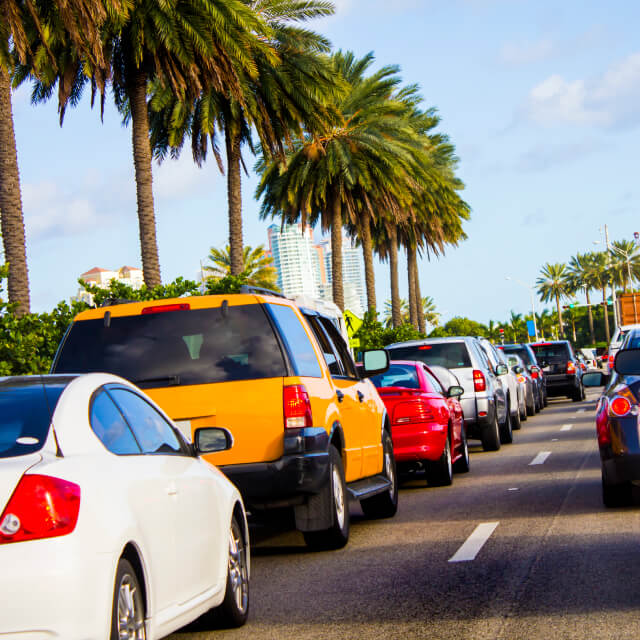
Finding affordable car insurance in Florida doesn’t have to be complicated. Freeway Insurance helps drivers compare options from multiple carriers, so you can find coverage that fits your budget, location, and driving needs.
Get a quote in the way that’s easiest for you:
- Online, with a fast quote in minutes
- In person, at a local Florida office
- By phone, by calling 800-777-5620 to speak with a licensed agent
Comparing quotes can help you avoid overpaying and ensure you meet Florida’s insurance requirements. With statewide support and flexible options, it’s easy to get the coverage you need — without unnecessary hassle. That way, you can feel confident you’re protected without overpaying.
Get your Florida car insurance quote today and see what you could save.
Auto Insurance Info by City
Arcadia

Cape Coral

Clearwater

Clewiston

Crestview

Deltona-Daytona Beach-Ormond Beach

Destin

Fort Lauderdale

Fort Myers

Fort Walton Beach

Gainesville

Jacksonville

Key West

Kissimmee

Lake City

Lakeland
Marco Island

Miami

Milton

Naples

North Port-Sarasota-Bradenton

Ocala

Okeechobee

Orlando

Palatka

Palm Bay-Melbourne-Titusville

Panama City
Pensacola

Port St. Lucie

Punta Gorda

Sebastian

Sebring

St. Petersburg

Tallahassee

Tampa

The Villages

Vero Beach

West Palm Beach

Winter Haven
By clicking Start Quote, I agree to the Privacy Policy and Terms of Use, which affect my rights.
By clicking Start Quote, I agree to the Privacy Policy and Terms of Use, which affect my rights.